
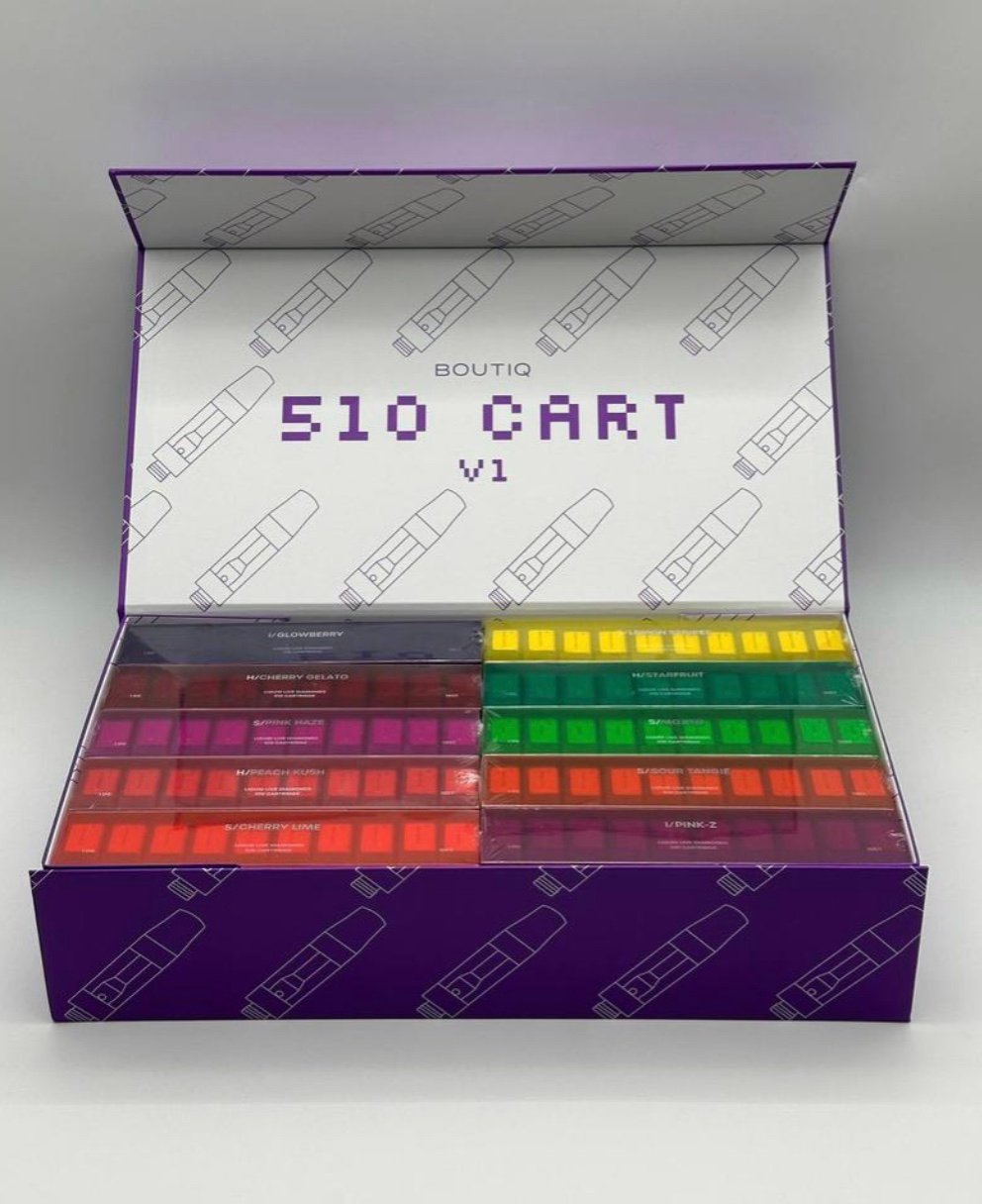
Boutiq 510 Cart V1
Price range: $40.00 through $1,800.00
Boutiq 510 Cart V1: Built for People Who Want Control
The Boutiq 510 Cart V1 is the answer to a specific complaint about disposables: they make every decision for you and then throw the hardware away. A 510 cartridge hands the decisions back. You choose the battery, you choose the voltage, and when the cartridge empties you replace a small component instead of an entire device.
Why Universal Threading Matters More Than It Sounds
510 threading is the nearest thing this industry has to an open standard, and open standards favour buyers. A cartridge that fits any compliant battery cannot be orphaned by a discontinued product line, cannot lock you into proprietary chargers, and cannot force you to accept whatever fixed voltage a manufacturer decided was adequate.
The practical payoff is temperature. Almost every complaint about cartridge flavor is a voltage complaint wearing a disguise. Terpenes — the compounds that carry aroma and taste — volatilize across a low band. Exceed it and they combust rather than vaporize, which produces a hotter, harsher vapor with a fraction of the character. A fixed-voltage device gambles that its single setting suits every extract it will ever hold. Owning the battery means you never have to take that gamble.
The Ceramic Core
Inside the Boutiq 510 Cart V1 is a ceramic heating element rather than a bare wire wrapped around cotton. The difference is heat distribution. Wire concentrates energy along a narrow filament, creating localized hot spots that scorch oil passing directly over them while under-heating oil a millimetre away. Ceramic spreads that same energy across a broad surface, lowering the peak temperature at any single point while producing the same total vapor.
Lower peak temperature has a compounding benefit. Less scorching means less carbon residue on the element. Less residue means the element does not progressively insulate itself and demand ever-higher temperatures to perform. That is the mechanism behind cartridges that taste as good at the bottom of the tank as at the top.
Intake port sizing is the other half of the design and gets almost no attention. Ports too narrow starve the element under a firm draw and produce a dry, burnt hit. Ports too wide flood the chamber, causing gurgling and leakage. Correct sizing is invisible engineering — you only notice it when it is absent, which is exactly why counterfeit hardware fails here even when the artwork is convincing.
Finding Your Voltage
Start low and work up, never the reverse. Begin at roughly 3.0 to 3.2 volts and take a test draw. If you get vapor and clear flavor, stay there — you have found your setting and there is no prize for going higher. Step up only if you get no vapor at all, and only in small increments.
Most people who report harshness are running somewhere near 4.0 volts because higher settings produce visibly bigger clouds. Cloud volume and flavor quality trade against each other. Decide which one you actually want before you set the dial.
If your battery has a preheat function, use it in cold conditions rather than raising voltage. Preheat gently warms the oil to a workable viscosity without pushing the element into the combustion range.
Preventing the Burnt First Hit
The most common cartridge failure happens in the first thirty seconds of ownership. Attach the cartridge and let it sit upright for five minutes before firing. The wick needs time to saturate, and firing a dry wick carbonizes it permanently — no amount of subsequent care undoes that damage.
After priming, draw slowly. A steady four to six second pull gives the wick time to keep pace with the element. Short, sharp hits move air past the coil faster than oil can be drawn in, which produces exactly the harsh, dry vapor people then blame on the extract.
Rest ten to fifteen seconds between draws. Chain-hitting outruns the wick regardless of how well the cartridge is built.
Storage and Travel
Store upright, at room temperature, out of direct sunlight. Sideways storage lets oil migrate into the mouthpiece and the central airway, which produces the gurgling and the mouthful of oil that follow. Heat thins the extract until it seeps past seals that would otherwise hold indefinitely.
For travel, detach the cartridge from the battery. A cartridge left attached in a bag can be fired accidentally by pressure on a draw-activated battery, and cabin pressure changes push oil through the airway of an attached unit more readily than a detached one.
Where It Fits in the Range
The cartridge format sits between two neighbours in the Boutiq catalog. Against a Boutiq 2G Disposable, it trades convenience for control and long-run economy — you carry a battery, but you stop discarding one with every purchase. Against Boutiq Concentrate Wax, it trades maximum control for far less handling; wax gives you complete command of dose and temperature but demands a tool, a dab rig or dedicated pen, and real technique.
For broader context on the cartridge line and how to verify what you are buying, see Boutiq Carts, and Boutiq Carts Price for the cost breakdown.
Frequently Asked Questions
Will this fit my existing battery? If your battery uses standard 510 threading, yes. That covers the overwhelming majority of pen-style batteries on the market.
Why is my cartridge leaking? Almost always storage position or heat. Store upright and away from heat sources. Persistent leakage from a cartridge stored correctly indicates a seal defect.
Can I refill it? It is not designed for refilling. The seals are single-use and reopening the housing creates a leak path that does not close again.
How do I clean the connection? A dry cotton swab on the threading and the centre contact, with the cartridge detached. Never use liquid solvents near the airway.
My cartridge tastes weak. Is it empty? Check the window first. If oil remains, let it rest upright for fifteen minutes to resaturate the wick, then draw gently. If it stays weak with oil visible, the element has reached the end of its service life.
For adult use only. Must be 21 or older to purchase. Keep out of reach of children and pets. Do not drive or operate machinery after use. These statements have not been evaluated by the FDA and this product is not intended to diagnose, treat, cure, or prevent any disease.
| Flavors | Lime Haze (Sativa), Mango Berry (Indica), Blinker Berry (Indica), Blue Haze (Sativa), RZ-11 (Indica), Arctic Frost (Hybrid), Blue Matcha (Sativa), Grape Ape (Indica), Baja Berry (Hybrid), Blue Mango (Indica), Mixed Flavors |
|---|---|
| Quantity | 2, 5, 10, 15, 25, 50, 100, 200 |
Be the first to review “Boutiq 510 Cart V1”
Related products

Boutiq Prerolls
Boutiq Switch V6
Boutiq Switch V5
Boutiq Flowers
Boutiq Switch V4
Disposable
Reviews
There are no reviews yet.