
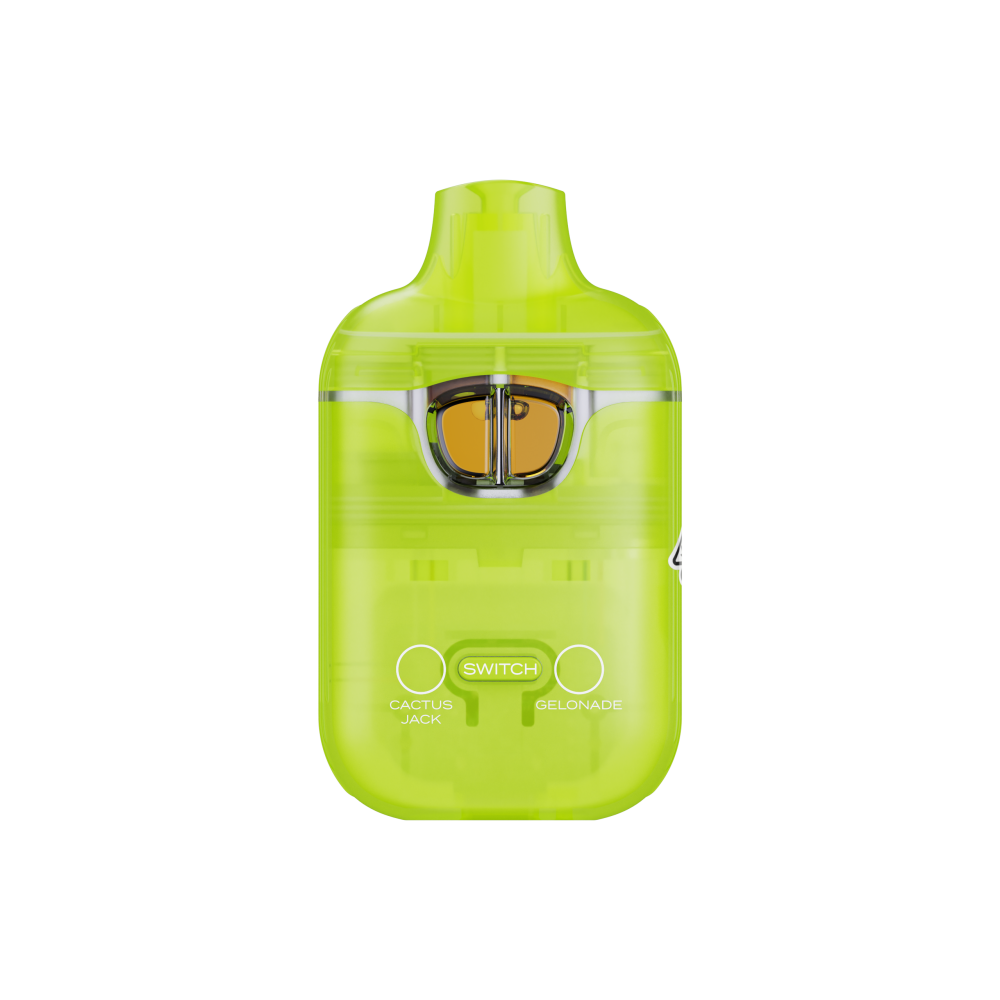
BOUTIQ SWITCH V3 CACTUS JACK X GELONADE: Two Approaches to Citrus, Only One of Them Sweet
This is the most interesting pairing in the Boutiq Switch V3 for anyone who pays attention to how flavors are constructed. Both chambers involve citrus, but one uses it as a sharp edge over a diesel base and the other buries it in cream. The result is two profiles that share an ingredient and share almost nothing else.Boutiq Switch Disposable
Cactus Jack: Citrus With a Fuel Backbone
Cactus Jack descends from haze and diesel lineages, and both parents are audible in the profile. The top note is bright and sharply citrus — closer to grapefruit peel than to lemon, with a rind-like bitterness that keeps it from reading as sweet.
Beneath that sits the diesel. It is not aggressive the way some fuel-forward strains are, but it is unmistakably there, providing a solvent-adjacent depth that gives the citrus something to push against. Without it the profile would be thin. With it, there is genuine structure.
Terpinolene supplies the sharp haze character at the top and is the most fragile element in the device. Caryophyllene provides the fuel note and a peppery finish. Limonene sits between them, carrying the citrus itself.
The effect reads as alert and forward. This is a daytime chamber and it does not pretend otherwise.
Gelonade: Lemon Folded Into Cream
Gelonade takes lemon in the opposite direction. Rather than sharpening it, the profile rounds it — lemon gelato rather than lemon zest, with a dairy-adjacent creaminess that softens the acidity almost completely.
The gelato lineage brings a dessert body that most citrus strains lack entirely, and it changes how the citrus lands. Instead of cutting, it brightens. Instead of finishing quickly, it lingers as something closer to custard.
Limonene remains present and dominant, but myrcene sits considerably heavier here than in the Cactus Jack chamber, supplying the body and the settling quality. Linalool contributes a soft floral note underneath that most people notice only when they go looking for it.
This is the evening side, and the weight difference between the chambers is substantial enough to be obvious.
Why the Pairing Is Cleverer Than It Looks
Most contrast pairings work by putting two unrelated flavors side by side — fruit against dessert, candy against gas. This one works by taking a single ingredient and treating it two entirely different ways.
The practical benefit is that switching between chambers does not feel jarring. There is a thread connecting them, so the transition reads as a change of register rather than a change of subject. Buyers who have found contrast pairings too abrupt often prefer this approach.
The practical cost is that if you dislike citrus, neither chamber will rescue the purchase. This is a device for people who already know they like the family.
Two Chambers That Need Different Handling
The chambers here have genuinely different tolerances, which is unusual and worth knowing.
Cactus Jack is fragile. Terpinolene is among the lightest compounds in cannabis and the first destroyed by heat. Run this chamber hot and you lose the haze sharpness entirely, leaving citrus over diesel with none of the lift that distinguishes it. The profile does not become bad, it becomes ordinary.
Gelonade is forgiving. Its heavier myrcene backbone and creamy body tolerate more heat before anything noticeable degrades. You should still run it gently, but it will not collapse if you do not.
In practice this means calibrating your technique to the Cactus Jack side. If you draw carefully enough to protect that chamber, the other side is comfortably covered.
Setup and Daily Use
Prime before first use by standing the device upright for several minutes so both wicks fully saturate. Firing a dry wick carbonizes it permanently and no later care undoes it.
Draw for four to six seconds, steadily. Rest fifteen seconds between draws on the Cactus Jack side, ten is adequate on Gelonade.
Take one gentle draw after switching chambers to establish flow in the dormant airway before pulling at full strength.
Two grams total across two isolated chambers with independent mesh coils, recharged over USB-C. Charge in short sessions with a modest adapter rather than overnight on a fast-charging brick, and let the device cool before drawing afterwards.
Store upright, cool, and away from direct sun. Heat exposure is permanent and it removes the sharp top notes first.
Comparable Devices
For citrus without the fuel element, Lime Haze x Pink Z keeps the haze character in a lighter frame. For a sourer approach, NYC Sour x Lemon Head pushes the acidity further. If the creamy dessert side is what draws you, Oreoz x Blueberry is the fuller expression of that direction.
Frequently Asked Questions
Is the diesel note strong? It is present and structural rather than dominant. Buyers who actively dislike fuel profiles will notice it; buyers who are neutral on them generally find it adds depth rather than distraction.
Does Gelonade actually taste creamy? Yes, noticeably so. The gelato lineage contributes a dairy-adjacent body that is unusual in a citrus-leaning strain.
Why has my Cactus Jack lost its sharpness? Heat, either from hard draws, chain-hitting, or hot storage. Terpinolene is unforgiving of all three and does not come back.
Which side should I use during the day? Cactus Jack. Gelonade carries considerably more myrcene weight and suits the end of the day better.
Is this a good pairing for someone new to the range? Only if you already like citrus. It is a focused device rather than a broad one.
For adult use only. Must be 21 or older to purchase. Keep out of reach of children and pets. Do not drive or operate machinery after use. These statements have not been evaluated by the FDA and this product is not intended to diagnose, treat, cure, or prevent any disease.
Reading the Lineage
Strain names in this category are often marketing rather than genetics, so it is worth noting what the lineages here actually contribute, because in this case they are audible in the product.
Haze varieties are responsible for the terpinolene-driven sharpness in the Cactus Jack chamber. Haze genetics have carried that signature since the strain family emerged decades ago, and it is one of the few flavor characteristics in cannabis that is genuinely tied to lineage rather than to processing. If a strain claims haze parentage and tastes flat and heavy, something is wrong.
Diesel lineages contribute the fuel note, which comes largely from caryophyllene and related compounds. This is also a stable inherited characteristic rather than something added downstream.
The gelato family, which stands behind Gelonade, brings the creamy dessert body. That family reliably produces profiles with more perceived weight and a longer, rounder finish than their citrus or haze counterparts, which is exactly the contrast this device is built on.
Knowing this is practically useful when you shop. A device pairing a haze-derived strain with a gelato-derived one will nearly always give you a genuine light-versus-heavy contrast, regardless of what the flavor names suggest.
Be the first to review “BOUTIQ SWITCH V3 CACTUS JACK X GELONADE”
Related products
Boutiq Switch V4

Boutiq Switch V4

Boutiq Switch V3
Boutiq Switch V4

Boutiq Switch V3
Boutiq Switch V4
Boutiq Switch V3

Boutiq Switch V5
Reviews
There are no reviews yet.